When “Pay Attention” Isn’t Enough:
Author: Kristina Rautek Potočnik, BA (Hons) Educational Rehabilitation, HDip Early Childhood Studies, MA Early Intervention & Inclusion, MA Therapeutic Pedagogy | Cert. Play Therapy | Sensory Integration (SI) | ASD | Primitive Reflexes | ABA | Currently undertaking Master’s studies in Comprehensive Speech Therapy and Clinical Neuropsychology & Neuroeducation, and Postgraduate Studies in Teaching.
For many children with ADHD, being told to “pay attention”, “calm down” or “think before you act” is not enough. The child may understand exactly what the adult wants, but still find it difficult to organise their attention, manage frustration, stop an impulsive response or move smoothly from one task to another.
This is why support needs to go beyond correction. Children often benefit from practical strategies that help them understand what is happening in their body, recognise what makes a situation difficult and learn what they can do next.
The workbook Thriving with ADHD Workbook for Kids uses a strength-based approach. Rather than focusing only on difficulties, it encourages children to identify their strengths, understand their challenges and build confidence through practical activities. The author emphasises helping children feel empowered while developing skills such as self-control, organisation, emotional regulation, focus and communication. Thriving with ADHD Workbook for…
ADHD Support Is About Skills, Not Just Behaviour
A child who struggles with focus may not be choosing to ignore an adult. A child who reacts strongly when something goes wrong may not yet have the strategies to manage that emotional response. A child who interrupts, moves constantly or forgets instructions may need more external structure before they can manage these demands independently.
The workbook describes self-regulation as knowing your body, your feelings and what you need in that moment to help yourself remain in control. It also places strong emphasis on recognising triggers before frustration becomes overwhelming.
For example, imagine a child who regularly becomes upset during homework.
The problem may not simply be “refusing to work”.
The child may be tired. The task may feel too difficult. They may not know where to start. There may be too many distractions. They may already expect themselves to fail.
Instead of:
“You need to stop getting angry and finish your homework.”
A more supportive approach might be:
“This part seems difficult. Let’s work out what is making it hard.”
Then the adult can help the child identify the trigger and choose a next step.
The workbook specifically encourages children to recognise situations that trigger anger or frustration and to think ahead about practical solutions. The goal is not to eliminate all frustration, but to increase awareness and preparation.
Emotional Regulation Begins Before the Outburst
Strong emotions are easier to support before they reach their highest point.
Children can gradually learn to notice early signals in their bodies. Perhaps their hands become tight. Their breathing changes. Their stomach feels uncomfortable. They start speaking louder. They feel like walking away.
These signals can become useful information.
Instead of waiting until the child is fully overwhelmed, adults can help them recognise:
“This is the point where your body is telling you that you need a break.”
The workbook includes strategies such as breathing, identifying triggers, using “I” statements and practising more flexible thinking. One example is “Elevator Breathing”, where a child places a light object or soft toy on their stomach and watches it move as they breathe slowly in and out. The purpose is to help the child slow their breathing when they feel angry, nervous or upset.
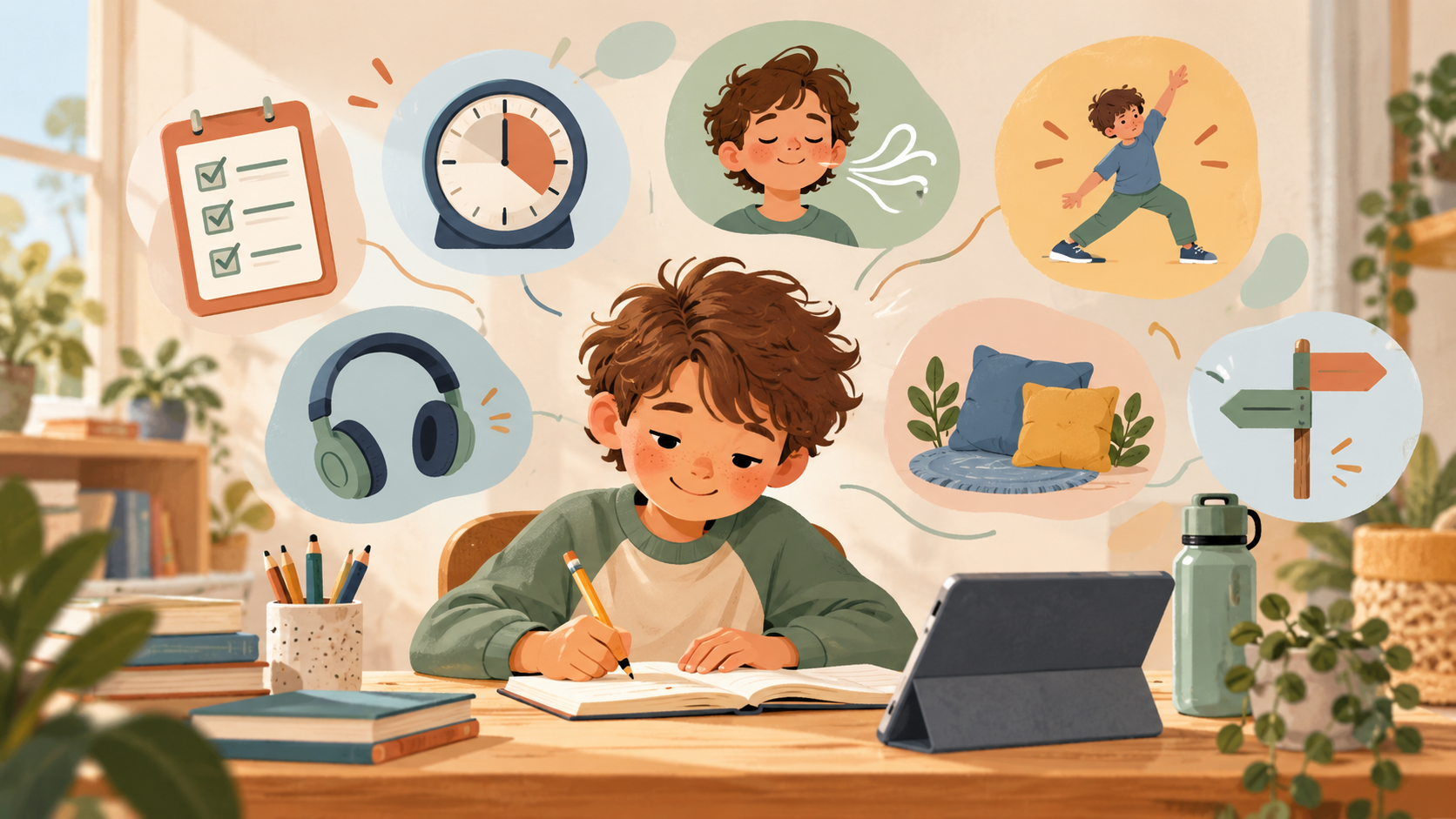
A calming space can also be useful when it is presented as a support rather than a punishment. A quiet corner with a cushion, books, a favourite sensory object or another calming item can give a child somewhere predictable to go when they feel overloaded.
The key distinction is important.
“Go to the calm corner because you are behaving badly” feels very different from:
“Your body looks like it needs some space. Do you want to use your calm area?”
“Calm Down” Needs to Become Something Concrete
Adults often use language that makes sense to us but gives the child very little information about what to actually do.
“Calm down.”
“Focus.”
“Control yourself.”
“Be sensible.”
These are outcomes, not strategies.
A child needs to know what the action looks like.
For example:
Instead of “Calm down”, try: “Put your feet on the floor and take three slow breaths.”
Instead of “Focus”, try: “Let’s do the first two questions, then take a short break.”
Instead of “Stop interrupting”, try: “Hold your thought. I’ll finish this sentence, then it’s your turn.”
Instead of “Make a better choice”, try: “What happened? What could you try differently next time?”
The workbook repeatedly approaches ADHD support in this practical way. It presents self-control, impulse management and decision-making as skills that can be learned and practised rather than simply expected.
Focus Is Not Always About Sitting Still
One of the most useful shifts for adults is understanding that successful concentration does not have to look the same for every child.
Some children work best in silence. Others may focus better with low background sound. Some need to sit. Others may work more effectively standing.
The workbook specifically encourages children to identify the environment in which they work best rather than assuming that only one form of concentration is acceptable.
This matters because adults can sometimes focus so strongly on what concentration should look like that they miss whether the child is actually engaged.
A child may be listening while moving.
A child may need to doodle while thinking.
A child may concentrate better after two minutes of movement.
A child may need a visual reminder to return to the task.
The workbook introduces “Emergency Focus Cards”, where children identify several short strategies that help them refocus, such as breathing, briefly moving, unclenching their hands or using another simple regulation strategy. Separate strategies can be identified for home and school.
This gives the child something more useful than hearing:
“Focus!”
They have a plan.
Make Tasks Smaller
Executive functioning demands can make even ordinary tasks feel much larger than adults realise.
Consider the instruction:
“Go upstairs, get changed, pack your schoolbag, brush your teeth and come back down.”
An adult may hear one simple instruction.
A child may hear five different tasks that must be remembered, sequenced and completed.
Breaking the task down reduces the amount the child has to hold in mind.
Try:
“First, get changed.”
Then:
“Now put your books in your bag.”
Then:
“Next, brush your teeth.”
Some children benefit from a written list, pictures or visual sequence.
The objective is not to permanently do everything for the child. External structure can act as a temporary support while the child develops greater independence.
Routines Reduce the Number of Decisions a Child Has to Make
The workbook gives routines a central role in supporting children with ADHD.
It explains that routines provide structure when attention is easily pulled away from the task. One practical example is preparing the night before: putting out clothes, packing the schoolbag, preparing lunch and placing important items in the same location.
A stressful morning might otherwise look like this:
“Where are your shoes?”
“Where is your homework?”
“Did you brush your teeth?”
“Why isn't your bag ready?”
“Come on, we're late!”
A routine changes the environment so that the child does not need to solve every problem from the beginning each morning.
For example:
Night before: clothes ready, schoolbag packed, jacket beside the bag.
Morning: get dressed, eat breakfast, brush teeth, take bag, leave.
Simple does not mean childish.
Simple means accessible.
The workbook specifically presents routines as a practical foundation for helping children remain on course and reduce stressful mornings.
Impulsivity Needs Reflection, Not Shame
Children with ADHD may sometimes act before fully considering what will happen next.
The important learning opportunity often comes after the event.
Instead of:
“Why would you do something so stupid?”
try:
“What happened first?”
“What were you thinking at that moment?”
“What happened next?”
“What could you try if this happens again?”
The aim is to help the child connect action and consequence.
The workbook includes activities that encourage children to think about decisions, reactions, choices and “do-overs”. This approach treats mistakes as opportunities to develop a better response next time rather than as evidence that the child is simply “bad at behaving”.
That distinction matters for self-esteem.
Language Can Support Emotional Control
Children also need language for difficult moments.
If a child only has two responses available — staying silent or exploding — emotional regulation becomes much harder.
Simple scripts can help.
“I need a break.”
“I don't understand.”
“This is too hard.”
“I feel angry.”
“Can you help me?”
“I need more time.”
The workbook introduces “I” statements as one way children can express strong feelings without immediately blaming the other person.
For example:
Instead of:
“You ruined everything!”
a child can gradually learn:
“I feel really upset because my game is broken.”
The emotion has not disappeared.
But the child has found a safer and more effective way to communicate it.
Build on What the Child Already Does Well
ADHD support should not become a daily catalogue of deficits.
A child who struggles with waiting may also be enthusiastic, imaginative and highly engaged in subjects they love.
A child who moves constantly may thrive in active learning.
A child who talks frequently may have strong ideas and enjoy social interaction.
A child who struggles with routine tasks may show remarkable persistence with an area of personal interest.
The workbook specifically begins with helping children identify strengths and qualities before moving into areas they find more difficult. It encourages children to recognise creativity, interests, kindness, imagination, energy and other individual strengths. Thriving with ADHD Workbook for…
This does not mean turning every ADHD difficulty into a “superpower”.
It means ensuring that the child's identity is not reduced to the things they find difficult.
What Support Can Look Like in Everyday Life
Effective support can be surprisingly ordinary.
It can mean putting a visual checklist beside the schoolbag.
It can mean giving one instruction instead of five.
It can mean noticing that a child is becoming frustrated before the situation escalates.
It can mean allowing movement before asking for another period of concentration.
It can mean helping the child build their own list of strategies instead of deciding everything for them.
It can mean asking:
“What helps you?”
That question is important because children need to gradually understand their own attention, emotions and regulation needs.
The long-term goal is not simply compliance.
It is helping the child become increasingly able to recognise:
What is happening to me?
What do I need?
What strategy can I use?
What can I try differently next time?
That is where support begins to become self-regulation.
Reference: Miller, K. (2018). Thriving with ADHD Workbook for Kids: 60 Fun Activities to Help Children Self-Regulate, Focus, and Succeed. Althea Press. Thriving with ADHD Workbook for…
Latest Posts
- How children make sense of the world through their senses
- How your baby learns about the world through their senses
- Helping your child grow stronger through movement and play
- Understanding How Early Intervention Helps Children Learn, Move, and Connect
- How to Recognise Tactile Defensiveness and Help Your Child Feel Safe
- Understanding Feeding Challenges and How to Support Your Child at Home
- Let’s Talk Sitting: Exploring Floor Seating Options
- Retained Primitive Reflexes: The Hidden Cause Behind Developmental Struggles
- Where Curiosity Blossoms: How Children's Play Nurtures Growth for All
- Helping Your Child Through Stress: A Gentle Guide for Parents
- Sweet Little Lies – How to Recognise and Respond with Care
- Chores Are More Than Just Tasks – They’re a Tool for Growing Independence, Focus, and Confidence
- How to Help Children Develop Emotional Intelligence
- Blending Technology and Care: How VR Meta Quest Supports Children at NeuroNest
- A simple guide for parents who want to raise confident, happy children
- Setting Boundaries with Love: A Simple 3-Step Guide for Parents
- Understanding Behavior Through the Nervous System
- A Compassionate Lens on Dysregulation in Non-Speaking Autistic Individuals
- Supporting Development Through Movement: The Role of the Swing in Early Intervention
- Blending Tradition and Innovation: How NeuroNest Supports Your Child’s Unique Journey
- When Movement Meets Innovation: Supporting Child Development with GoBalance
- Why Visual Perception Matters for Everyday Life and Development
- Benefits of Chess in Early Intervention
- Building Healthy Nutrition from the Start
- A Journey Back to Your True Self
- Supporting Your Child’s Hand Skills for Confident Writing
- Blending the Best of Both Worlds
- Helping Toddlers Eat Well: A Parent’s Guide
- Why Tummy Time Matters for Your Baby's Development
- Helping Your Child Build Everyday Independence
- Who Are the Disconnected Kids?
- From First Tries to Automatic Habits: Understanding the Stages of Skill Learning
- Why a Child’s Level of Alertness Matters for Memory and Learning
- Early brain development starts before birth
- Why Slowing Down, Adapting Tasks, and Adding Breaks Helps Children Learn Better
- Why ADHD, Autism, Dyslexia and Other Challenges Need a New Approach
- The surprising power of copying in child development
- Books are more than just language tools—they’re powerful allies in sensory and motor development.
- Rethinking sensory support: moving beyond expensive rooms toward everyday understanding.
- Understanding how fear develops in a child’s brain
- Understanding how an early baby reflex can affect your child’s daily life
- A gentle start into baby development through movement and bonding
- A child-centred, research-informed approach that uses the power of play to support communication, emotional regulation, motor development, and meaningful growth from infancy to twelve years.
- Why Rising Autism Diagnosis Rates Do Not Indicate an Epidemic
- ADHD in the Classroom: Practical Strategies That Support Attention, Engagement and Learning
- OCD in Children and Adolescents: Early Signs, Impact and Evidence-Based SupportOCD in Children and Adolescents: Early Signs, Impact and Evidence-Based Support
- Understanding the Whole Child in Early InterventionUnderstanding the Whole Child in Early Intervention
- Supporting Development Beyond the Session
- Understanding How Confidence, Independence and Initiative Develop in Childhood
- How Everyday Routines Can Support Children’s Communication and Emotional Regulation
- Helping Children with ADHD Build Focus, Self-Control and Emotional Regulation
- What Parents Should Know About Pacifier Use, Oral Development and Early Communicationw
Our Partners



Our Memberships