How Children Build Confidence: Understanding Erikson’s Early Stages of Development
Author: Kristina Rautek Potočnik, BA (Hons) Educational Rehabilitation, HDip Early Childhood Studies, MA Early Intervention & Inclusion, MA Therapeutic Pedagogy | Cert. Play Therapy | Sensory Integration (SI) | ASD | Primitive Reflexes | ABA | Currently undertaking Master’s studies in Comprehensive Speech Therapy and Clinical Neuropsychology & Neuroeducation, and Postgraduate Studies in Teaching.
Children do not develop confidence, independence and a sense of identity all at once. These qualities grow gradually through everyday experiences with parents, caregivers, teachers and other important adults.
One useful way of thinking about this process comes from developmental psychologist Erik Erikson, who proposed eight stages of psychosocial development across the lifespan. His theory focuses on the relationship between emotional development and the child’s social environment. In each stage, Erikson described a particular developmental “conflict” or challenge that the person is working through. erikerikson-stagesofdevelopment…
For families of young children, the first four stages are particularly relevant because they relate to trust, independence, initiative and confidence.
It is important to remember that developmental theories are frameworks, not checklists. Children do not all move through development in exactly the same way or at exactly the same age. Erikson’s theory has also been criticised for some concepts being difficult to measure and for lacking precision. erikerikson-stagesofdevelopment…
Still, the framework can help adults think about an important question:
What is this child learning about themselves through the way adults respond to them?
Stage One: Trust vs. Mistrust
Erikson described the first stage as Trust vs. Mistrust, beginning in infancy. At this stage, babies are completely dependent on adults. Consistent warmth, physical care and predictable responses help the infant begin to experience the world as safe and dependable. erikerikson-stagesofdevelopment…
This does not mean that a parent must respond perfectly every second.
It is about the overall pattern.
Imagine a baby waking and crying during the night. The baby cannot yet understand that a parent is tired or that it is 3 a.m. The baby simply experiences discomfort and communicates it in the only way available.
When an adult regularly responds by picking the baby up, feeding them, changing them or offering comfort, the baby gradually experiences:
“When I need help, someone usually comes.”
That repeated experience contributes to a developing sense of trust.
The same principle continues beyond infancy.
A young child who becomes overwhelmed in a busy room may look toward a familiar adult, move closer to them or ask to leave. When the adult notices the signal and provides appropriate support, the child is learning that adults can be a source of safety.
Trust therefore begins with relationships.
Stage Two: Autonomy vs. Shame and Doubt
During early childhood, Erikson described a growing need for autonomy. The child begins wanting to do things independently, control their own body and make choices. The source material describes autonomy as doing things for oneself and making choices, while excessive ridicule or overprotection may contribute to doubt in the child’s abilities. erikerikson-stagesofdevelopment…
This stage is very easy to recognise.
It is the toddler who says:
“Me do it!”
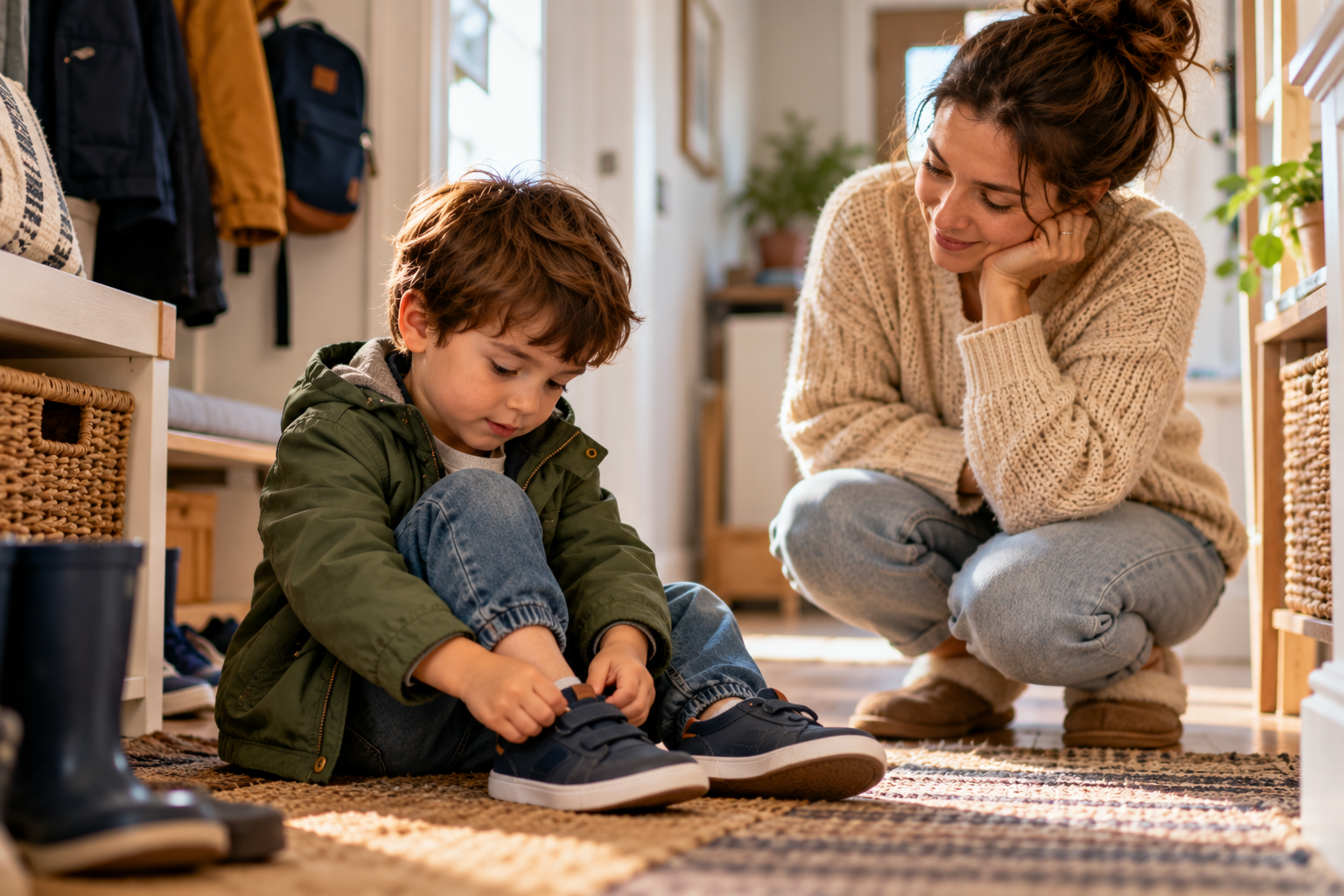
They want to put on their shoes.
They want to pour the drink.
They want to press the button.
They want to choose the red cup instead of the blue one.
For adults, this can sometimes be frustrating because allowing independence often takes longer.
A parent can put a child’s coat on in ten seconds.
The child might need three minutes, put one arm into the wrong sleeve and become frustrated halfway through.
But that struggle is part of learning.
Instead of immediately taking over, an adult might say:
“You do the zip first. I’ll help if you need me.”
Now the child still experiences ownership of the task.
Autonomy does not mean that children should be allowed to make every decision. Young children still need clear boundaries.
A useful approach is to offer limited choices.
Instead of:
“Do you want to get dressed?”
Try:
“Would you like the green top or the blue top?”
The expectation remains the same—getting dressed—but the child experiences some control within a safe boundary.
Stage Three: Initiative vs. Guilt
Erikson’s third stage, Initiative vs. Guilt, is associated with the preschool years. During this period, children increasingly explore, imagine, ask questions and begin activities of their own.
The source describes initiative as being supported when adults allow children opportunities to play, use imagination and ask questions. erikerikson-stagesofdevelopment…
Anyone who spends time with a preschool child knows how visible this stage can be.
“Why is the sky blue?”
“Why does the dog sleep?”
“Can I make a rocket?”
“Can we build a shop?”
“What happens if I mix these colours?”
These questions and ideas are not interruptions to development.
They are development.
Imagine a four-year-old who decides that the sofa is now a pirate ship.
The cushions become islands.
A cardboard tube becomes a telescope.
The adult has two possible ways of responding.
One response might be:
“Stop making a mess. Put everything back.”
Another might be:
“You’ve made a pirate ship. Where are you travelling?”
The second response does not mean the child never needs to tidy up. It simply recognises the child’s initiative before introducing the next expectation.
Later, the adult can say:
“Your pirate adventure is finished. Let’s put the cushions back together.”
That balance allows creativity and boundaries to exist at the same time.
Stage Four: Industry vs. Inferiority
As children enter the school years, Erikson described Industry vs. Inferiority.
At this stage, children increasingly compare their abilities with tasks, expectations and other people. School becomes particularly important because children encounter more academic and social demands. Erikson associated successful experiences at this stage with a developing sense of competence. erikerikson-stagesofdevelopment…
This is why the way adults respond to effort can matter so much.
Consider two children completing the same writing task.
One child writes quickly and neatly.
Another child finds handwriting difficult. Their letters are uneven and the page contains several corrections.
If the second child repeatedly hears:
“Your work is messy.”
“Everyone else finished already.”
“You’re not trying.”
they may gradually begin to think:
“I’m bad at this.”
But the same child could receive feedback such as:
“You stayed with that task even when it was difficult.”
“You remembered where three of your letters start.”
“Let’s work on one part at a time.”
The difficulty has not disappeared.
But the message has changed.
The child is learning:
“I can improve.”
That distinction is important.
Confidence does not come from telling children that everything they do is perfect.
It develops when children experience genuine success, appropriate challenge and adults who recognise progress.
The Same Behaviour Can Mean Different Things at Different Developmental Stages
Understanding development can also help adults interpret behaviour more carefully.
A two-year-old refusing help with shoes may be exploring autonomy.
A four-year-old interrupting constantly with ideas may be showing initiative.
An eight-year-old becoming very upset after making a mistake may be struggling with their developing sense of competence.
The behaviour itself is only part of the picture.
The more useful question is:
What developmental need might be underneath this behaviour?
This does not mean that every behaviour should be accepted without boundaries.
Children still need guidance.
But guidance is usually more effective when adults understand what the child is trying to develop.
Independence Does Not Mean Doing Everything Alone
One misunderstanding about development is that independence means removing adult support.
It does not.
Children generally develop independence through supported independence.
A toddler may hold the spoon while the parent steadies the bowl.
A preschool child may choose the activity while an adult helps organise the materials.
A school-aged child may complete most of a task independently but receive help planning the first step.
The support gradually changes as the child becomes more capable.
The goal is not:
“You must do this alone.”
The goal is:
“I will help you do as much as you can, and we will build from there.”
Why This Matters in Early Intervention
In early intervention, we often look beyond whether a child can simply complete a task.
We also consider how the child experiences themselves while doing it.
Does the child feel safe enough to try?
Can they make a choice?
Can they tolerate making a mistake?
Can they ask for help?
Do they experience success?
Can they return to something after finding it difficult?
These experiences contribute to much more than performance in one activity.
They contribute to the child’s developing sense of:
I am safe.
I can try.
My ideas matter.
I can learn.
I can ask for help.
That is why everyday interactions matter.
A child’s development is shaped not only by big milestones, but also by hundreds of small moments with the adults around them.
A parent waiting a few extra seconds before helping.
A teacher noticing effort rather than only correctness.
A caregiver allowing a child to choose between two options.
An adult responding to a mistake with:
“Let’s try again.”
These moments may look small.
For the developing child, they can carry a much bigger message:
“I am capable, and I am still learning.”
Latest Posts
- How children make sense of the world through their senses
- How your baby learns about the world through their senses
- Helping your child grow stronger through movement and play
- Understanding How Early Intervention Helps Children Learn, Move, and Connect
- How to Recognise Tactile Defensiveness and Help Your Child Feel Safe
- Understanding Feeding Challenges and How to Support Your Child at Home
- Let’s Talk Sitting: Exploring Floor Seating Options
- Retained Primitive Reflexes: The Hidden Cause Behind Developmental Struggles
- Where Curiosity Blossoms: How Children's Play Nurtures Growth for All
- Helping Your Child Through Stress: A Gentle Guide for Parents
- Sweet Little Lies – How to Recognise and Respond with Care
- Chores Are More Than Just Tasks – They’re a Tool for Growing Independence, Focus, and Confidence
- How to Help Children Develop Emotional Intelligence
- Blending Technology and Care: How VR Meta Quest Supports Children at NeuroNest
- A simple guide for parents who want to raise confident, happy children
- Setting Boundaries with Love: A Simple 3-Step Guide for Parents
- Understanding Behavior Through the Nervous System
- A Compassionate Lens on Dysregulation in Non-Speaking Autistic Individuals
- Supporting Development Through Movement: The Role of the Swing in Early Intervention
- Blending Tradition and Innovation: How NeuroNest Supports Your Child’s Unique Journey
- When Movement Meets Innovation: Supporting Child Development with GoBalance
- Why Visual Perception Matters for Everyday Life and Development
- Benefits of Chess in Early Intervention
- Building Healthy Nutrition from the Start
- A Journey Back to Your True Self
- Supporting Your Child’s Hand Skills for Confident Writing
- Blending the Best of Both Worlds
- Helping Toddlers Eat Well: A Parent’s Guide
- Why Tummy Time Matters for Your Baby's Development
- Helping Your Child Build Everyday Independence
- Who Are the Disconnected Kids?
- From First Tries to Automatic Habits: Understanding the Stages of Skill Learning
- Why a Child’s Level of Alertness Matters for Memory and Learning
- Early brain development starts before birth
- Why Slowing Down, Adapting Tasks, and Adding Breaks Helps Children Learn Better
- Why ADHD, Autism, Dyslexia and Other Challenges Need a New Approach
- The surprising power of copying in child development
- Books are more than just language tools—they’re powerful allies in sensory and motor development.
- Rethinking sensory support: moving beyond expensive rooms toward everyday understanding.
- Understanding how fear develops in a child’s brain
- Understanding how an early baby reflex can affect your child’s daily life
- A gentle start into baby development through movement and bonding
- A child-centred, research-informed approach that uses the power of play to support communication, emotional regulation, motor development, and meaningful growth from infancy to twelve years.
- Why Rising Autism Diagnosis Rates Do Not Indicate an Epidemic
- ADHD in the Classroom: Practical Strategies That Support Attention, Engagement and Learning
- OCD in Children and Adolescents: Early Signs, Impact and Evidence-Based SupportOCD in Children and Adolescents: Early Signs, Impact and Evidence-Based Support
- Understanding the Whole Child in Early InterventionUnderstanding the Whole Child in Early Intervention
- Supporting Development Beyond the Session
- Understanding How Confidence, Independence and Initiative Develop in Childhood
- How Everyday Routines Can Support Children’s Communication and Emotional Regulation
- Helping Children with ADHD Build Focus, Self-Control and Emotional Regulation
- What Parents Should Know About Pacifier Use, Oral Development and Early Communicationw
Our Partners



Our Memberships